
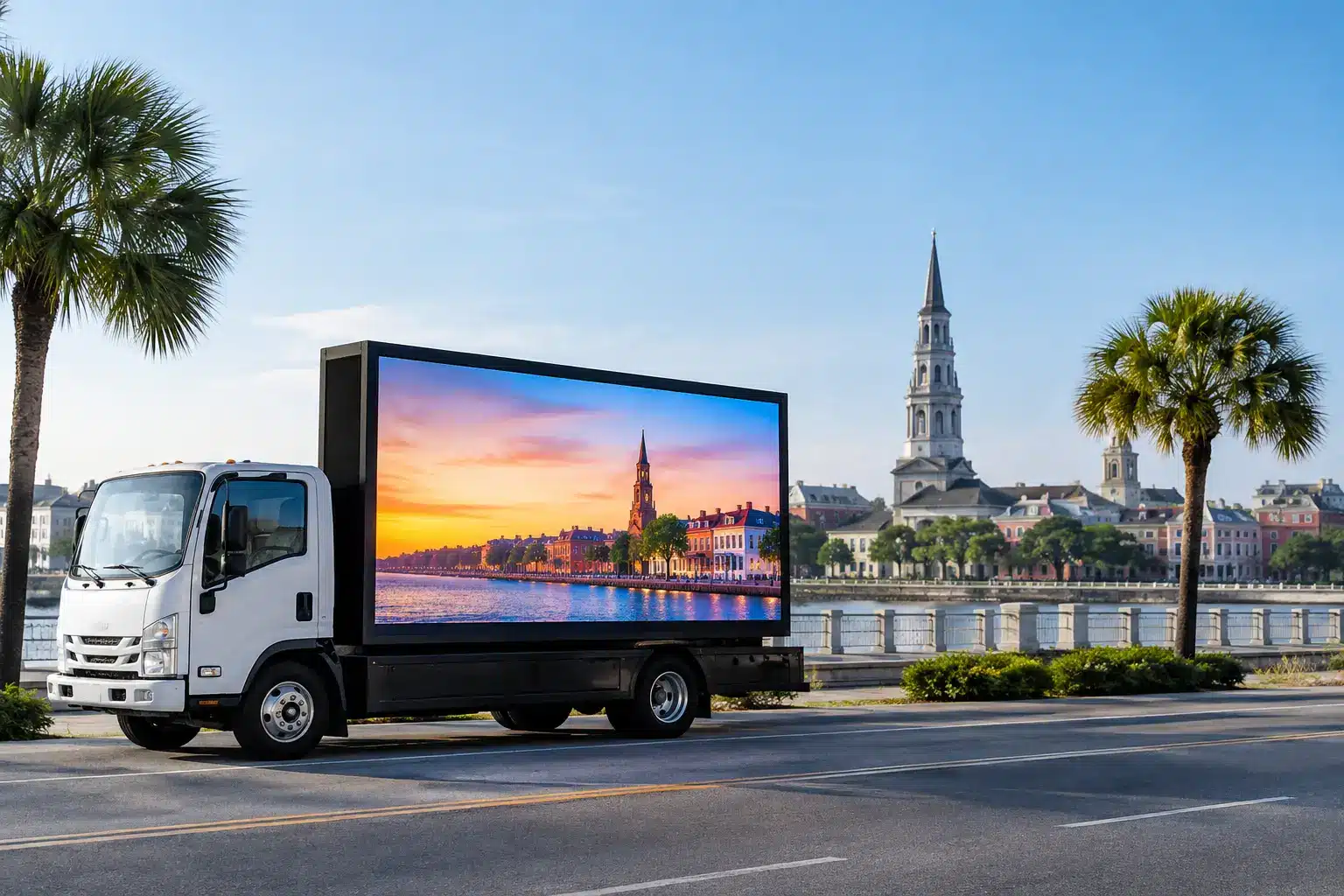
A work truck sitting at a job site is easy to overlook. A clean, professionally wrapped truck with a bold logo, clear services, and a phone number turns that same parking spot into a local ad people remember. That is the opportunity behind this mobile billboard advertising guide: putting the vehicles you already operate to work for your brand wherever they go.
For Charleston businesses, the route is the media buy. Whether your crew is moving between West Ashley, Mount Pleasant, Summerville, North Charleston, and downtown job sites, your vehicles can create repeated visibility in the neighborhoods where future customers live and work. A wrap is not just decoration. It is a high-impact local branding tool that keeps showing up long after a digital ad campaign ends.
Why vehicle wraps work as mobile billboards
Most local advertising asks people to stop what they are doing. A vehicle wrap meets them in the course of their day: at a traffic light, in a parking lot, outside a restaurant, in a neighborhood, or on the way to work. That repeated, real-world exposure is what builds recognition.
A well-traveled commercial vehicle can generate an estimated 30,000 to 70,000 daily views, depending on its route, location, time on the road, and whether it spends time in high-traffic areas. A service van that moves through residential neighborhoods may create more targeted local exposure than a vehicle making a short warehouse-to-warehouse run. The number is useful, but the quality of those impressions matters just as much.
For contractors, home-service companies, food operators, delivery businesses, retailers, and local fleets, the biggest advantage is relevance. Your truck is seen in the market you serve, often near the exact homes, businesses, and events where customers need you. A sharp wrap also provides credibility. When a branded team arrives, customers see an established business rather than an unmarked vehicle they may hesitate to trust.
Start with the route, not the design
A mobile billboard needs a strong design, but the strategy begins with how your vehicle actually moves. Before choosing colors or graphics, consider where it goes, how often it drives, and who sees it.
A landscaping company with trucks on the road all day has a different opportunity than a caterer whose trailer appears at weekend festivals. A food truck needs to be recognizable from a distance and memorable when people are deciding where to eat. A plumber’s van should communicate trust, services, and contact details in seconds while parked in a driveway. A box truck making regional deliveries may have room for bigger visuals, but it also needs messaging that reads clearly at highway speed.
Ask a few practical questions: Is the vehicle usually moving or parked? Does it serve one neighborhood or the entire Lowcountry? Is the goal name recognition, direct calls, recruiting, event traffic, or a new service launch? The answers determine what the wrap needs to do.
A mobile billboard cannot be all things to all people. One focused message gets noticed. Five competing messages get ignored.
What your vehicle wrap should say
The most effective commercial wraps make the brand easy to identify before trying to explain everything. At a glance, people should understand who you are and what you do.
Your business name or logo needs a clear visual home. Your primary service should be immediately readable, especially if the company name does not explain it. A roofing company, for example, should not assume every passing driver knows it installs roofs. A simple phrase such as “Roofing & Exterior Repair” removes the guesswork.
Then add one easy way to act. For many local businesses, that means a phone number and website. A short service-area phrase can help when it is relevant, such as “Serving Charleston & the Lowcountry.” QR codes can be useful on parked vehicles, trailers, or food trucks, but they should never replace readable contact information. Nobody can safely scan a code while driving behind your van.
Avoid treating every open panel like a flyer. Too much small text becomes visual noise. Strong contrast, large type, and a clear hierarchy do more for recall than a long list of services. If a person sees your truck for three seconds at an intersection, they should leave with your name and a reason to remember it.
Match the wrap scope to the vehicle’s job
A full wrap makes the biggest visual statement. It creates a finished, branded look across the entire vehicle and gives designers the most space to use color, photography, patterns, and large-format messaging. It is often the best choice for businesses that depend on visibility and want a true rolling billboard.
A partial wrap can be a smart option when the budget is tighter or the vehicle already has a strong factory color that works with the brand. Used strategically, partial coverage can still look intentional and high-end rather than like a few disconnected decals.
Spot graphics and lettering are ideal for smaller branding needs, fleet consistency, or vehicles that require a clean, understated appearance. They can display your logo, contact information, licensing details, and core services without covering the full body. The right option depends on your goals, vehicle type, and how much visual impact you need from each unit.
Design for a moving audience
A vehicle is not a brochure. People view it quickly, from changing angles, in different light, and often from several lanes away. That makes readability the first rule of mobile billboard design.
Use brand colors that stand apart from the vehicle’s base color and the surrounding road environment. Make key lettering large enough to read at a glance. Keep the most important information on the side panels and rear, where traffic is most likely to see it. The rear doors of a van, trailer, or box truck are valuable space because drivers may be stopped directly behind you.
Photos and detailed illustrations can look outstanding when used with restraint. A strong image of finished work, a signature product, or a recognizable local visual can help a wrap stand out. But if the image competes with the logo or obscures the message, it is working against the campaign.
Great wrap design also respects the vehicle itself. Door seams, handles, windows, rivets, body contours, and rear access points all affect how graphics are planned and installed. A design that looks good on a flat computer layout may need adjustment to look right on an actual work van or trailer. That is why vehicle-specific measurements and experienced installation matter.
Measure more than impressions
Impressions are a valuable starting point, but businesses should track whether a wrap is producing attention that turns into opportunities. Ask new callers how they heard about you. Add a unique call tracking number only if it fits your operations. Use a memorable landing-page phrase or campaign-specific offer when appropriate. Sales teams can also record when prospects mention seeing the fleet around town.
The clearest result may be improved recognition. People often call a company they have seen repeatedly because the name feels familiar when a need finally arises. That means vehicle advertising works especially well when it is part of a consistent local presence that includes quality service, reviews, referral relationships, and other marketing efforts.
There are trade-offs. A wrap will not fix unclear positioning, poor customer service, or a business that rarely operates in its target market. It also may not be the fastest channel for an immediate, highly specific promotion. But for long-term local visibility, the cost per thousand impressions can be highly efficient because the vehicle keeps generating exposure during normal business operations.
Keep your mobile billboard working hard
A premium vinyl wrap is designed for the road, but it still benefits from care. Regular washing keeps colors bright and prevents road grime from hiding the details people need to see. Use gentle cleaning methods, avoid abrasive brushes, and address any edge lifting or damage early. A neglected wrap sends a message too, and it is not the message you want associated with your business.
When your services, logo, phone number, or brand colors change, update the fleet with a plan rather than letting old and new branding overlap for years. Consistency across trucks, vans, trailers, and specialty vehicles is what turns individual impressions into genuine market recognition.
Prepare before requesting a wrap quote
A productive wrap project starts with accurate details. Have your vehicle year, make, model, body style, and photos ready. For trailers, box trucks, and specialty units, include measurements and note doors, windows, rivets, ladders, awnings, or equipment that may affect the design.
You should also bring a clear idea of the wrap scope, your logo files, preferred colors, key services, contact details, and the areas you want to reach. If your business already has brand guidelines, share them early. If it does not, that is the right time to define a look that can grow across the fleet.
Charleston Wraps helps local businesses turn cars, trucks, vans, trailers, food trucks, and specialty vehicles into attention-getting brand assets built for the real conditions of the road. Start with the vehicle that gets seen most often, give it one message people can remember, and let every mile put your business in front of the next customer.