
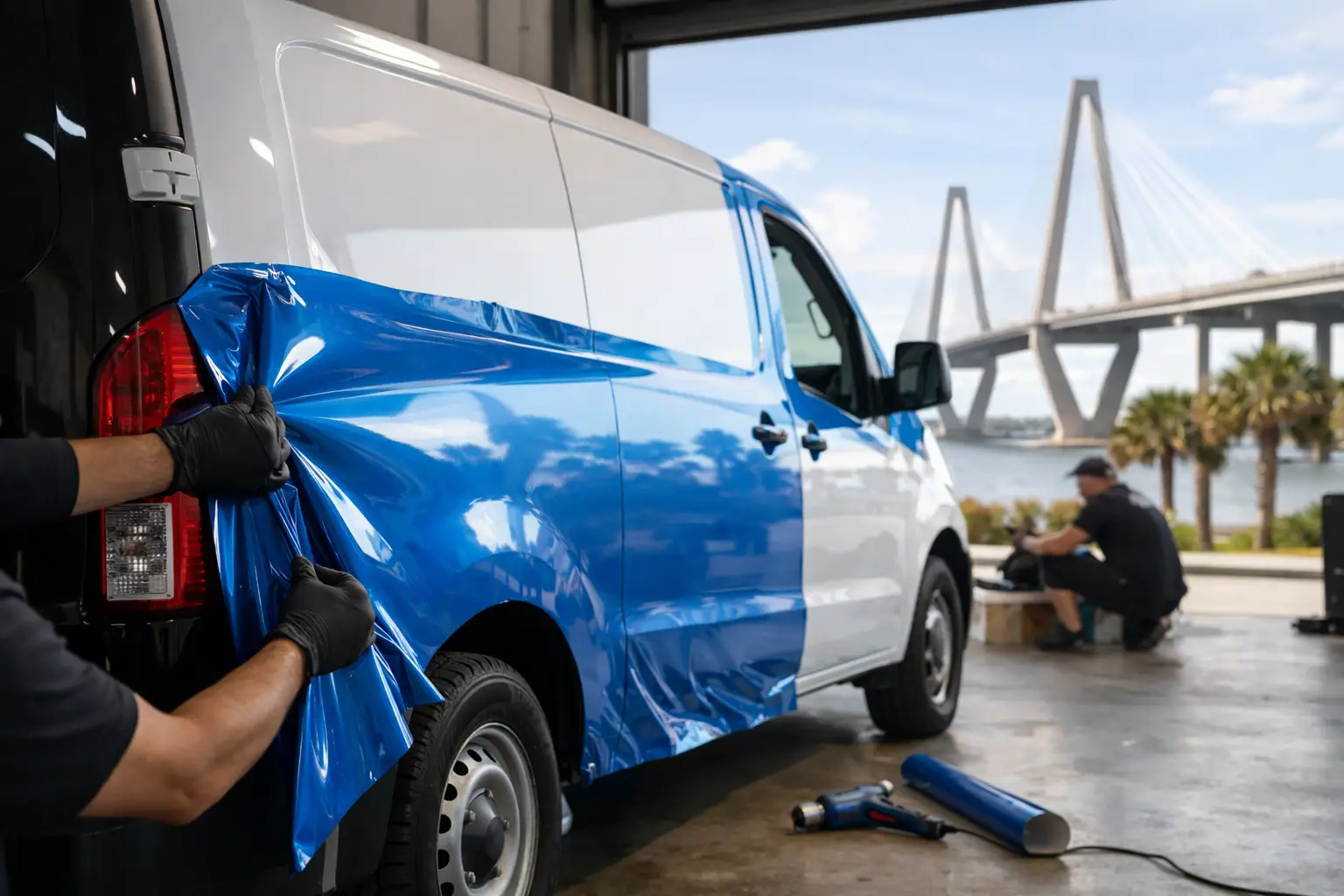
A plain work van can blend into Charleston traffic. A professionally wrapped van can put your name, services, phone number, and brand in front of potential customers all day. The first question is usually, how much does a vehicle wrap cost? The honest answer is that it depends on the vehicle, the coverage, the design, and the condition of the surface. A wrap is custom-built for your exact project, not pulled from a shelf.
For businesses, that custom investment can create serious visibility. A branded vehicle can generate an estimated 30,000 to 70,000 daily views as it moves through job sites, neighborhoods, parking lots, and local roads. For personal vehicles, a wrap delivers a dramatic color change or one-of-a-kind design without committing to permanent paint.
How Much Does a Vehicle Wrap Cost?
Most professionally installed vehicle wraps fall into broad ranges rather than one flat price. A small set of cut vinyl graphics may start in the hundreds, while a full commercial wrap for a van, truck, or trailer can run into several thousand dollars. Full color-change wraps, specialty finishes, food truck graphics, box truck wraps, and fleet programs are priced according to their own scope.
As a practical starting point, many projects fit within these general ranges:
- Simple lettering, logos, and partial graphics: roughly $500 to $2,000
- Partial wraps for cars, pickups, or vans: roughly $1,500 to $3,500
- Full wraps for standard cars, trucks, and cargo vans: roughly $3,000 to $6,000+
- Large vehicles, box trucks, trailers, food trucks, and specialty builds: often $5,000 to $10,000+ depending on size and coverage
Those ranges are not a substitute for a quote. A compact sedan with a clean, solid-color commercial layout is a very different job from a wrapped Sprinter van with deep body channels, full-color photography, window graphics, and a detailed installation schedule. The right question is not just what a wrap costs, but what is included in the finished result.
What Drives Vehicle Wrap Pricing?
Vehicle size and body complexity
More square footage requires more vinyl, more printing, and more installation time. That is why a full wrap on a two-door coupe generally costs less than a full wrap on a cargo van or box truck.
Size is only part of the equation. Doors, handles, mirrors, bumpers, rivets, deep channels, roof rails, spoilers, ladders, and recessed panels all add installation complexity. A trailer may look like a simple rectangle, but its trim, doors, hardware, and surface condition can affect the final price.
Full wrap, partial wrap, or spot graphics
Coverage has one of the biggest effects on cost. A full wrap changes nearly every visible painted panel. A partial wrap uses strategic graphics on selected areas, often paired with the vehicle’s existing paint color. Spot graphics may include a logo, service list, phone number, DOT information, or a bold door treatment.
A partial wrap can be a smart move for contractors and small businesses that need a clean, credible look without the investment of full coverage. It is not automatically the best option, though. If the brand needs to be highly visible from every angle or the vehicle has faded paint that should disappear under a new look, a full wrap may deliver more impact.
Design direction and artwork readiness
A simple logo placed on clean color blocks takes less design time than a custom illustrated concept with product photography, multiple messages, and unique graphics for each side. If you already have usable logos, brand colors, fonts, and high-resolution images, the design phase can move faster.
That does not mean a basic design is always better. A food truck may need menu-focused panels, social media details, bold food imagery, and a look that creates a line before the window opens. A home-service business may need to make its phone number readable from traffic. Good wrap design is not decoration alone. It is built around what people need to notice first.
Material selection and finish
Premium cast vinyl is engineered to conform around curves and contours while holding up outdoors. It is the right material for quality, long-term vehicle wraps. Specialty finishes such as matte, satin, metallic, color-shifting, chrome, textured films, reflective vinyl, or protective overlaminates can increase the price.
For a personal color change, finish selection is often the feature that makes the project. For a commercial wrap, the priority may be bold color, legible branding, and durability. Both approaches should use materials that fit the application instead of chasing the lowest possible upfront number.
Surface preparation and existing conditions
Vinyl needs a stable surface. Fresh paint may need time to cure. Failing clear coat, peeling paint, rust, oxidation, body damage, silicone residue, and old decals can create problems before installation begins.
Removing an old wrap or adhesive residue adds labor, especially if the film has been on the vehicle beyond its expected lifespan. Surface repairs are usually separate from wrap installation, but addressing them first protects the quality of the finished job. A wrap can transform a vehicle’s appearance. It cannot make deteriorating paint structurally sound.
Commercial Wrap Cost vs. Advertising Value
A commercial vehicle wrap is more than a graphics expense. It is a local advertising asset that works while your team drives to calls, parks at projects, and moves through the communities you serve. Unlike a short campaign that disappears when the budget runs out, a quality wrap continues to show up every day.
The value depends on how the vehicle is used. A plumbing van that travels across Charleston five days a week has different exposure than a trailer that leaves the yard twice a month. A fleet with consistent branding can build recognition quickly because repeated sightings make a business feel established.
Think beyond the initial price. If a $4,500 wrap lasts several years and generates thousands of daily impressions, the monthly visibility cost can be remarkably efficient. The same wrap can also support trust at the job site. Customers are more likely to feel comfortable when a technician arrives in a clearly marked, professional vehicle.
Choosing the Right Scope for Your Budget
A strong project starts by matching the wrap scope to the job the vehicle needs to do. A single service van may benefit from a full wrap that dominates the road. A growing fleet may need a repeatable partial-wrap system that keeps multiple vehicles consistent. A pickup used for estimates and supply runs might only need door logos, a phone number, and a sharp tailgate treatment.
Do not squeeze too much information onto the design just because space is available. Drivers and pedestrians have seconds to understand your message. In most cases, your business name, core service, phone number or web address, and memorable visual identity matter more than a long list of offerings.
For personal builds, decide whether the goal is transformation, protection, or both. A full color change makes a vehicle stand out. A chrome delete can modernize trim without wrapping every panel. Paint protection film may be the better choice for owners who love their factory color and want to defend high-impact areas from road debris and scratches.
Questions to Ask Before Requesting a Quote
The fastest way to get an accurate vehicle wrap quote is to provide the exact year, make, model, and body style, along with clear photos from all sides. For commercial projects, share your logo files, service area, required contact information, and whether the vehicle is a daily driver, part of a fleet, or a specialty unit.
It also helps to define the coverage you have in mind. Are you considering a few graphics, a partial wrap, or full coverage? Do you need design help? Is there an existing wrap to remove? Do you have a deadline tied to a launch, event, or busy season? These details turn a rough price conversation into a practical plan.
Charleston Wraps builds quotes around the vehicle and the goal behind it, whether that means a hardworking contractor truck, a standout food trailer, or a custom color change that makes your ride feel entirely new.
The best next step is to look at your vehicle the way your customers do: as moving space that can either disappear into traffic or make a clear, memorable impression every mile it travels.