
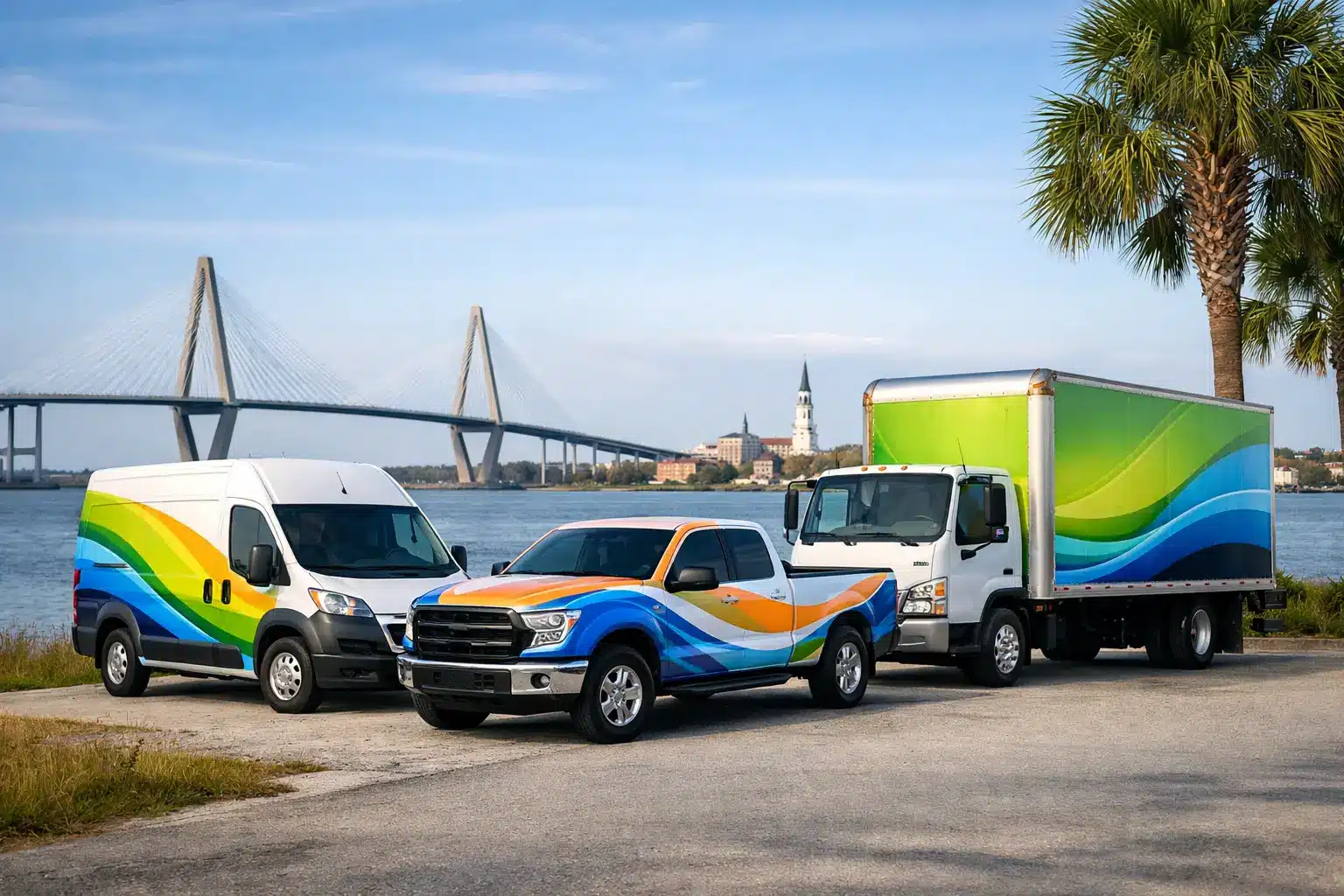
A service van parked at a job site, a box truck rolling down I-26, and a food trailer set up for a weekend event all have something most ads do not: they are already where your customers live, work, and make buying decisions. Commercial vehicle wraps Charleston businesses put on the road turn those necessary trips into visible, local brand impressions.
For contractors, fleet operators, restaurants, retailers, and service businesses, a professionally wrapped vehicle is more than a good-looking truck. It is an always-on advertising asset that builds familiarity route by route. The right wrap helps people recognize your name before they need your service, then remember it when they do.
Why a Wrapped Vehicle Works Harder Than a Parked Sign
Your vehicles move through Charleston’s busiest neighborhoods, job sites, business districts, parking lots, and event spaces. That daily exposure can add up quickly. A commercial wrap may generate an estimated 30,000 to 70,000 views per day, depending on the vehicle, route, parking habits, and how often it is on the road.
That does not mean every impression turns into an immediate call. Mobile advertising works through repetition. Someone sees your plumbing van near West Ashley one week, notices it again in Mount Pleasant, then searches for your company when a pipe leaks. A homeowner sees your landscaping trailer in their neighborhood and remembers the name when it is time to improve the yard.
This is why vehicle graphics can be especially effective for businesses that serve a defined local area. You are not paying to show your message to a broad audience that may never need you. Your brand is seen in the same communities where your crews work and where prospective customers are likely to ask, “Who did that job?”
Commercial Vehicle Wraps Charleston Companies Can Build Around
There is no single right wrap package. The best choice depends on the vehicle, the role it plays in your business, the condition of its paint, and how much visibility you need. A one-vehicle startup may need a clean identity package that makes a professional first impression. A growing fleet may need consistent graphics that look identical across vans, trucks, trailers, and specialty units.
Full Wraps Make a Strong First Impression
A full wrap covers most or all of the painted exterior with printed vinyl. It is built for businesses that want maximum visual impact, bold color, and room for photography, patterns, service details, or a larger campaign message.
Full wraps are a strong fit for box trucks, food trucks, trailers, delivery vehicles, and high-mileage service fleets. They make the vehicle difficult to miss, which is valuable when visibility is the goal. They also offer a practical benefit: quality wrap film can help shield the original paint from everyday sun exposure, minor scuffs, and road debris.
The trade-off is investment. Full wraps require more material, more design planning, and more installation time than partial graphics. They are often worth it for vehicles that are highly visible or central to your customer experience, but a full wrap is not automatically the best use of budget for every vehicle.
Partial Wraps Deliver Big Visibility With Less Coverage
A partial wrap uses vehicle contours, printed graphics, color blocks, and existing paint to create a complete branded look without covering every panel. Done well, it should look intentional, not like a logo was dropped onto the doors as an afterthought.
This option works especially well for pickup trucks, work vans, SUVs, and fleet vehicles where clean, recognizable branding matters more than a wall-to-wall campaign. A partial wrap can highlight your company name, primary services, phone number, and web address while keeping costs more controlled.
The key is design discipline. If the vehicle color clashes with your brand palette or the graphics are too small to read from the road, the savings can cost you visibility. Strong layout, contrast, and simple messaging matter more than filling every available inch.
Lettering and Spot Graphics Keep It Focused
For businesses that need straightforward identification, cut vinyl lettering and spot graphics can provide a sharp, professional result. This is often a practical choice for smaller fleets, newer businesses, or vehicles that need required company information alongside a logo and contact details.
A clean logo on the doors, a service line on the rear panel, and a readable phone number can go a long way. But basic does not have to mean forgettable. Color, spacing, placement, and type size determine whether the vehicle reads as established and trustworthy or disappears into traffic.
Design for the Road, Not the Computer Screen
A wrap can look impressive in a design proof and still fail from 40 feet away. Commercial vehicle graphics need to be designed for quick recognition at speed. Drivers and pedestrians have seconds, not minutes, to understand who you are and what you offer.
Start with the information that matters most: your logo or company name, your core service, and one clear way to contact you. If your brand is already well known, a large logo and memorable visual system may be enough. If you are building recognition, adding a short service description can eliminate confusion. “Heating and Air,” “Coastal Catering,” or “Commercial Roofing” tells people exactly why they should remember you.
Avoid turning the vehicle into a brochure. Long lists of services, tiny social handles, and multiple competing calls to action often become unreadable visual noise. A wrap should create a strong first impression first. The details can live on your website, estimate form, or sales materials after a customer decides to look you up.
Color deserves real planning in Charleston, too. Bright, high-contrast graphics can stand out under strong coastal sunlight, while dark-on-dark text can disappear. For food trucks and retail concepts, expressive artwork may be part of the draw. For trade fleets, a confident, consistent system usually builds more trust than a crowded design trying to say everything at once.
The Vehicle Type Changes the Strategy
A van gives you broad side panels that can carry a clear message. A pickup has less uninterrupted space, so door graphics, tailgate branding, and bed-side placement become more important. A box truck provides a large moving billboard, while a trailer can reinforce your name at job sites long after the truck has left.
Food trucks and food trailers deserve their own approach. Their wrap has to attract attention, communicate the menu concept, and look great in photos without making ordering information hard to find. For these businesses, the vehicle is not just transportation. It is the storefront, the sign, and a major part of the guest experience.
Fleet consistency matters when you operate more than one unit. Vehicles do not have to be the same make, model, or color to look like one company. A defined logo position, color palette, typography, and graphic style create recognition across the entire fleet. That consistency makes a small fleet look larger and helps a large fleet feel organized.
What to Prepare Before Your Wrap Project
A smoother project begins with clear information. Before design and installation, decide what each vehicle needs to accomplish. Is the priority brand awareness, a service launch, lead generation, vehicle identification, or a more polished fleet appearance? The answer guides the scope.
Gather current logos, brand colors, any existing marketing materials, and accurate vehicle details. Photos help, but year, make, model, body style, and dimensions help ensure the design matches the exact vehicle. For trailers, box trucks, and specialty units, panel measurements, door locations, rivets, windows, and equipment access points all affect the layout.
It also helps to think through logistics. The vehicle should arrive clean, with no fresh paint work, significant rust, loose trim, or failing clear coat in the areas being wrapped. Vinyl performs best on sound, properly prepared surfaces. If a vehicle is heavily used, plan installation around your work schedule so the downtime does not surprise your team.
At Charleston Wraps, commercial projects are built around the real vehicle and the real job it needs to do. That means designing for cars, trucks, vans, box trucks, trailers, food trucks, and food trailers with the details of the application in mind, not forcing every project into the same template.
A Better Way to Think About Wrap ROI
The value of a commercial wrap is not measured only by calls that come in the day after installation. Its biggest advantage is repeated local exposure over time. Unlike a short digital campaign or a one-time mailer, your branded vehicle keeps working when it is driving, parked at a job, fueling up, or loading supplies.
Track the response where you can. Ask new customers how they heard about you, use a memorable phone number or dedicated landing page in your broader marketing system, and watch for increases in direct searches for your business name. Just as important, notice the qualitative signals: people recognizing your team at job sites, mentioning your truck, or calling because they have seen your vehicles around town.
The strongest commercial vehicle wraps do not try to do every marketing job at once. They make your business recognizable, believable, and easy to remember. Put that standard on every vehicle that represents your company, and every route becomes a chance to earn the next familiar face, call, or contract.